Creation alone is insufficient in the fast-paced digital world of today. If your blog or video isn’t optimised, it may never reach the people who need it most. Content optimization can help with that.
Consider content optimisation to be similar to engine tuning. Even if your car is powerful, it won’t run as well if it isn’t tuned properly. In a similar vein, in order to rank higher in search results, draw in the right audience, and encourage meaningful engagement, your content needs to be strategically optimised content
Knowing how to optimize your content can significantly impact your online presence, regardless of your role as a blogger, business owner, or digital marketer. What’s the best part? To get it right, you don’t have to be an expert in technology.
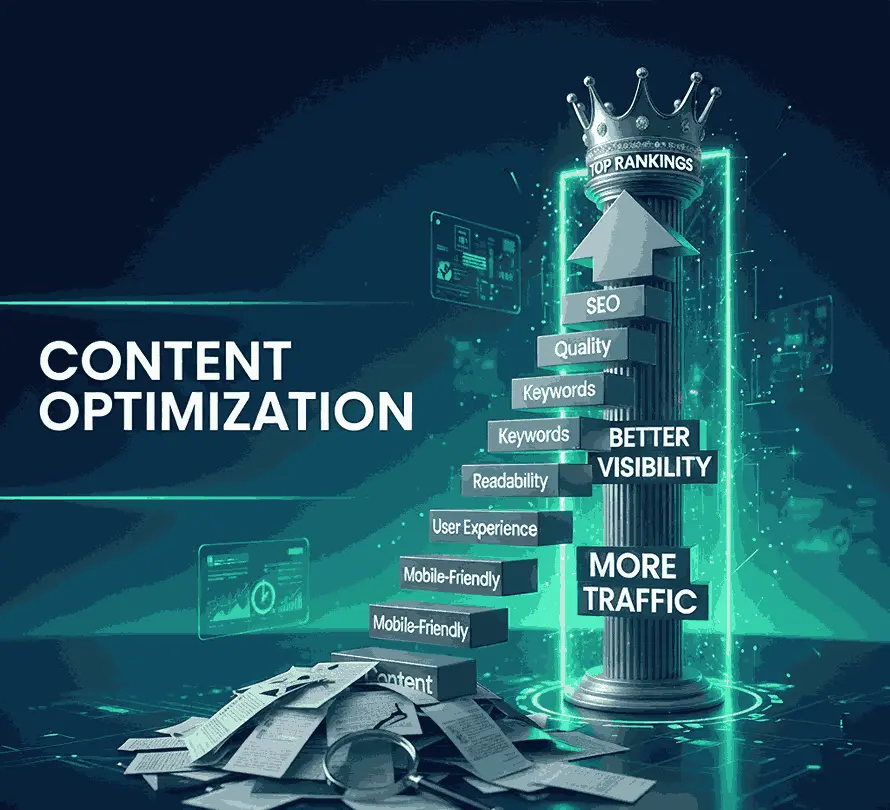
What Is Content Optimization?
Fundamentally, content optimisation is the process of making your content more valuable, visible, and search engine friendly. This is applicable to: Blog entries
- Pages on websites
- Pages for landing
- Descriptions of products
- Infographics and videos
- The objective is straightforward: Create content that is both enjoyable for readers and simple for search engines to comprehend.
- Content optimisation benefits you:
- Increase your ranking in search engine results
- Increase natural traffic to your website
- Boost conversions and engagement
- Gain credibility in your field.
Content Optimization vs. SEO — What’s the Difference?
While SEO (Search Engine Optimization) and content optimization are similar, they are not the same. SEO encompasses a greater scope, including non-content based technical variables, such as site structure, page speed, backlinks, and indexing.
In contrast, content optimization is primarily focused on improving the content itself, in terms of keyword usage, formatting, internal linking, and readability. If you think of SEO as the overall blueprint of your online presence, then you can think of content optimization as the engine that keeps your blueprint working. SEO ensures discoverability of your site, while content optimization ensures your content performs, once discovered.
Key Elements of Effective Content Optimization
Think of it this way: SEO is the structure and content optimization is the engine that keeps your content running efficiently. Without content optimization, SEO structure will not work at its highest level.
To properly optimize content, you will want to pay attention to some important points that balance user experience and search engine understanding.
The first is strategic keyword usage. Keywords serve as a multitasking signpost that helps search engines better understand where to classify your content. Start with a primary keyword (e.g. “content optimization”), and supplement that with secondary or long-tail keywords. In this case, terms like “content optimization tools,” “on-page SEO techniques,” or “how to optimize blog content” all capture similar search intents.
Once you have a variety of keywords selected, use them naturally throughout content; the title, URL, meta title, meta description, subheadings, first paragraph of the content, and image alt text are all natural places for the keyword. Once again, do not overdo it — keyword stuffing is not helpful for you or your audience. Always write for humans first, and search engines as a second thought.
The second step to optimizing your content is writing for content experience-and a structure that Google likes. Users and search engines like the content to be clear, easy to read, and organized. Consider short paragraphs, headings (H2 and H3) for structure, and bullet points or lists where appropriate. Use bold or italics to highlight words that help sketch out an idea.
This lends itself to reading – and searching – better overall and provides a signal to Google as to what the section conveys. An organized and clear structure improves readability, keeps users engaged, and decreases bounce rate, which all contribute to improved SEO impact.
Another important factor is content quality that puts the user first. Google rewards content that displays E-E-A-T, which stands for Experience, Expertise, Authoritativeness, and Trustworthiness. In short, you need to produce original, deep, and accurate content that meets the intent of the user.
Always try to answer the reader’s question thoroughly, provide actionable information and share examples or case studies when possible. And once you are done writing, ask yourself: Would a first-time user find this helpful? If the answer is “yes”, then you are on the right track.
The Power of Internal and External Linking
Links are vital for optimizing your content. Internal links can help connect your pages, allowing users to explore your site while passing SEO value between pages. Additionally, internal links help search engine crawlers navigate your content hierarchy and ensure every one of your pages is indexed appropriately.
External links, which point to trusted, authoritative sources, increase your trustworthiness and provide readers with more context. One best practice is to use anchor text that is informative, such as “learn more about on-page SEO,” rather than a vague phrase like “click here.” A well-linked piece of content serves as a web of information that is easily digestible for both users and search engines.
Optimizing Meta Data
Often the first thing a user sees on Google is your meta title and description, so you want to make these count. Keep your title below 60 characters and include your main keyword. Write an intriguing meta description (under 155 characters) that summarizes your content while convincing the user to click.
For example, instead of a boring description like “Learn content optimization tips,” try: “You will find practical content optimization strategies to enhance your SEO, increase engagement, and attract the right audience.” This will increase your click-through rate which is another positive ranking signal.
Media and Visual Optimization
Content consists of more than just words – visual elements are also vital. Images, infographics, and video elements make content more appealing and help get the message across quickly. However, if visuals are not optimized it can impact your page load time, which can hurt user experience as well as search engine rankings.
Always compress images so the page will load more quickly, always use keywords in your naming, use descriptive file names, and include alt text with relevant keywords. Also use visuals whenever possible, keeping them near the relevant text to support context. In general, users will stay on a page longer with visual content included, which signals to the search engines that the page is a valuable piece of content.
Common Content Optimization Mistakes
Several marketers inadvertently ruin their SEO initiatives by not examining a few fundamental issues with their optimized content. One of the biggest pitfalls is ignoring search intent altogether – using keywords that do not accurately reflect what users are actually searching for.
Other examples would be writing big blocks of text with little formatting, not updating older blog posts, omitting internal links, or not optimizing for mobile users. Having written all of that, now none of this possible to not use mobile devices today in a world where smartphones are the most common method of searching. Having a responsive site and content can go a long way with rankings and user gratification.
The Ultimate Content Optimization Checklist
- Include the main keyword in the title, meta tags, headers, and URL.
- Structure content with headings and bullet points.
- Ensure your content satisfies users’ search intent.
- Add internal and external links.
- Optimize the meta title and description.
- Compress and tag images.
- Proofread for clarity, grammar, and tone.
- Make sure you have a clear call-to-action that directs the reader to the next step.
Best Tools for Content Optimization
free of errors and assumable. You can also analyse user behaviour with Hotjar so that you can see what readers are looking for during the reading process. Fortunately, you won’t have to do everything on your own! You can use tools like Google Analytics and Google Search Console to help you monitor traffic levels, performance, and pages that are not performing.
Surfer SEO or Clear scope analyses keyword density and suggest changes, and a well-known WordPress plugin called Yoast SEO manages on-page search engine optimization by checking your titles, meta tags, and readability. Ahrefs and Semrush are both excellent tools for keyword
Advanced Optimization Tips
If you already know the basics, there are some advanced techniques to help you go above and beyond what you have implemented. First, you may want to try repurposing your content. For example, you can turn a blog post into a video, infographic, or podcast episode to reach a new audience. You can implement structured data (schema markup) to make it easier for Google to understand what type of content you are creating.
You could also try optimizing for featured snippets. This can be accomplished by answering a specific question in a short amount of content. Make sure to evaluate your performance regularly and update your top-performing posts. Lastly, you can look into using AI tools to brainstorm content ideas, usability, or readability, but always redefining it.
Conclusion
Content optimization is not merely a marketing fad — it is the backbone of a sustainable online experience. When done correctly it will not only help your content rank better in search engines, but also enhance how long readers stay engaged with your content and increase your potential to turn visitors into followers or customers. Pick one piece of content, optimize that content based on a standardized checklist of items, and check your analytics for performance. Over time, these small incremental improvements will yield massive improvements in visibility and authority.
Keep in mind that the Google algorithm fundamentally rewards the content that helps users. Instead of being overly focused on ranking factors, be focused on the value you are providing. Once you satisfy both the users and the search engine, that’s when the real magic happens.
Frequently Asked Questions
What is the primary aim of content optimization?
The primary aim of content optimization is to enhance visibility and relevance and improve the user experience to rank higher in search and competitive outlook, while Grammarly and Hemingway guarantee your writing is drop off.
How often should I optimize my content?
Ideally, update and review your content every 3–6 months or every time there is a significant update to Google algorithm to remain fresh and competitive.